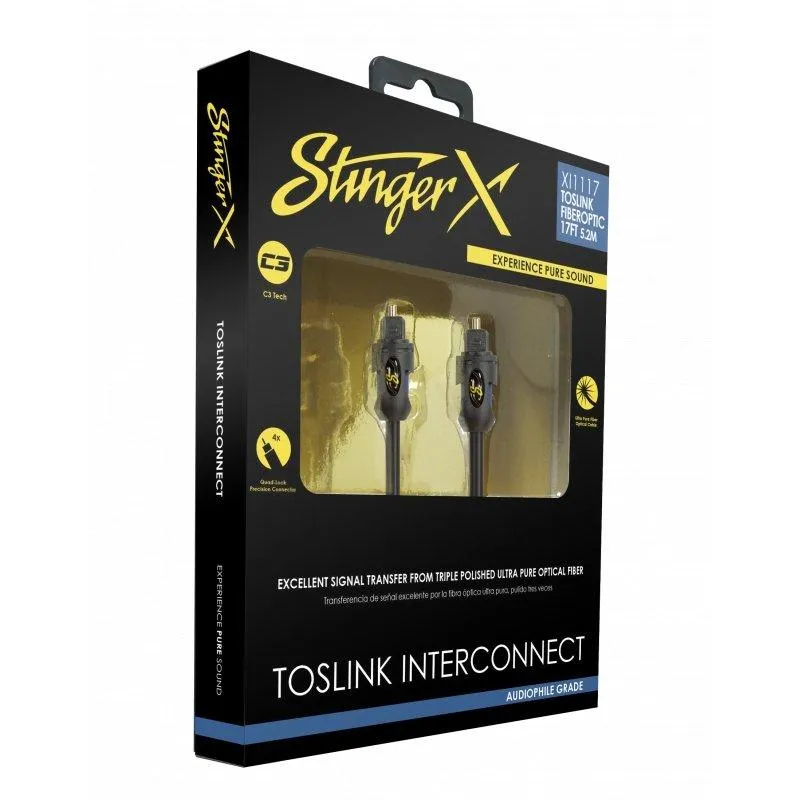
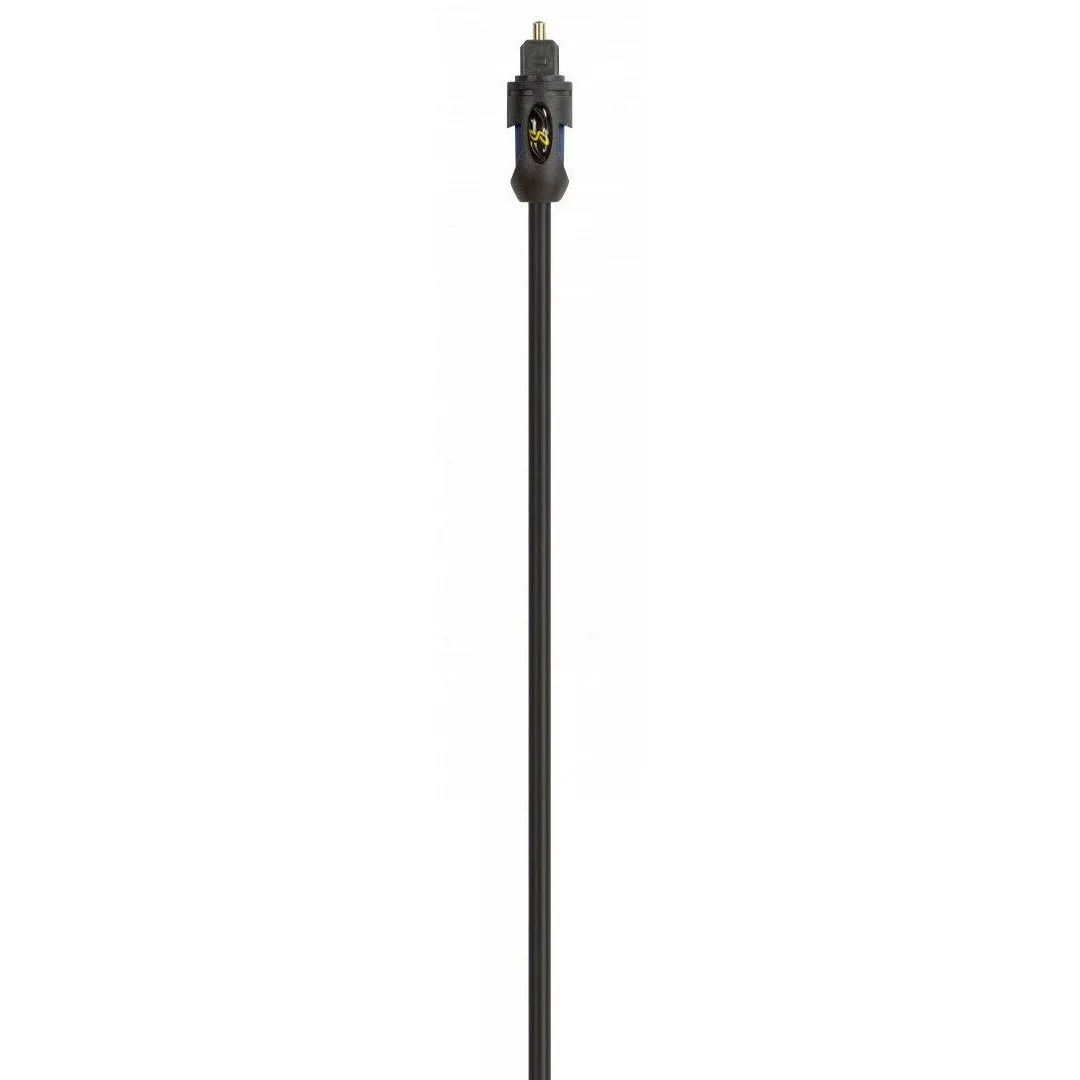
Stinger XI1117 X Series 17ft Toslink Optical Interconnect
The Cleanest Digital Signal Path in Car Audio 17ft Toslink Optical Interconnect Built for DSP and High-Performance Installs
Product Overview
The Stinger XI1117 is a 17-foot (5-metre) Toslink optical interconnect from the X Series range, engineered to provide the cleanest possible digital audio connection between source units, DSP processors, PAC AmpPRO vehicle interfaces, and Stinger Infotainment systems. Unlike RCA cables that carry audio as an analogue electrical signal, the XI1117 transmits audio as light making it completely immune to electromagnetic interference, alternator whine, ground loops, and every other form of electrical noise that degrades signal quality in the automotive environment.
The cable uses a medical-grade light-conductive fibre optic core, triple-polished at both ends to maximise light transfer efficiency and minimise the optical data errors that cause digital jitter and sonic degradation. Stinger's proprietary C3 Tech (Continuous Connection Construction) method ensures no breaks in the optical signal chain across the full 17-foot length. A Quad-Lock precision connector resists vibration for a secure, consistently aligned connection. The flexible non-reflective PVC dielectric jacket allows routing through tight dash and cabin spaces without risk to the fibre core. Hi-Res Audio ready, with support for 5.1 and 7.1 DTS and Dolby Digital.
At 17 feet, the XI1117 covers the full run from a dash-mounted source or head unit to a boot-mounted DSP processor in most vehicles without the need for extension.
Key Specifications
- Manufacturer Part Number / SKU: XI1117
- Series: X Series
- Cable type: Toslink optical
- Length: 17ft (5 metres)
- Core material: Medical-grade light-conductive fibre optic
- Connector finish: Triple-polished
- Connector type: Quad-Lock Stinger Toslink
- Construction method: C3 Tech (Continuous Connection Construction)
- Outer jacket: Durable automotive-grade
- Inner insulation: Flexible non-reflective PVC dielectric
- Multi-channel support: Yes — 5.1 and 7.1 DTS, Dolby Digital
- Hi-Res Audio ready: Yes
- Noise immunity: Total — optical transmission, no electrical connection
- Frequency response: Extended beyond RCA capability
Features & Benefits
- Medical-Grade Fibre Optic Core — Manufactured to medical-grade standards for maximum optical clarity and signal transmission precision. This level of core quality directly reduces digital jitter and data errors, resulting in more detailed and accurate sound reproduction at the receiving DSP or processor.
- Triple-Polished Connector Ends — Both ends are triple-polished to create the smoothest possible light-emitting and receiving surfaces. Each polishing step removes microscopic surface imperfections that scatter light, maximising total light transfer and minimising data errors at the connection point.
- Total Noise Immunity — Audio transmitted as light rather than electrical current is immune to electromagnetic interference from alternators, ignition systems, mobile devices, and all other electrical noise sources in the vehicle. No shielding is required and no ground loops can form.
- Extended Frequency Response Beyond RCA — The optical digital signal path supports a frequency response far beyond the 20kHz ceiling of the analogue audio spectrum and beyond the practical capability of any RCA cable, making the XI1117 suitable for Hi-Res Audio sources and processors.
- Multi-Channel Audio Support — Supports 5.1 and 7.1 DTS and Dolby Digital multi-channel audio formats, providing full bandwidth for DSP processors and digital interfaces requiring multi-channel throughput over a single cable.
- C3 Tech — Continuous Connection Construction — Stinger's proprietary construction method ensures no breaks or discontinuities in the optical signal chain throughout the full 17-foot cable length, providing consistent signal transfer from source to destination.
- Quad-Lock Precision Connector — Resists vibration and mechanical stress in the automotive environment, maintaining a secure, correctly aligned connection at the optical interface — critical for consistent digital signal integrity.
- Flexible Non-Reflective PVC Dielectric Jacket — The non-reflective inner insulation prevents internal light scattering. The flexibility of the jacket allows routing through tight dash and cabin spaces without exceeding the minimum bend radius of the fibre core.
Technical Specs
| Specification | Detail |
|---|---|
| SKU | XI1117 |
| Series | X Series |
| Cable Type | Toslink Optical |
| Length | 17ft (5 metres) |
| Core Material | Medical-grade light-conductive fibre optic |
| Connector Finish | Triple-polished |
| Connector Type | Quad-Lock Stinger Toslink |
| Construction Method | C3 Tech (Continuous Connection Construction) |
| Outer Jacket | Durable automotive-grade |
| Inner Insulation | Flexible non-reflective PVC dielectric |
| Multi-Channel Support | Yes — 5.1 and 7.1 DTS, Dolby Digital |
| Hi-Res Audio Ready | Yes |
| Noise Immunity | Total — optical, no electrical connection |
| Frequency Response | Extended beyond RCA capability |
Compatible With / Goes Well With
- DSP processors with Toslink optical input (e.g. Rockford Fosgate DSR1, Morel MDSP series and equivalents)
- PAC AmpPRO vehicle interfaces with Toslink output
- Stinger HEIGH10 infotainment systems with TOSLINK output
- Any source unit or head unit with Toslink optical output
- Boot-mounted DSP and processor installations requiring a full-length dash-to-boot optical run
Caution: Observe a minimum bend radius of at least 25–30mm at any point in the routing path. Do not bend sharply, kink, or route the cable through clips that compress it tightly — damage to the fibre core is permanent and will degrade optical performance. The flexible PVC jacket aids routing but does not protect the core from sharp bends.
Frequently Asked Questions
Why use a Toslink optical cable instead of an RCA cable for DSP connections?
An RCA cable transmits audio as an analogue electrical signal susceptible to electromagnetic interference from alternators, ignition systems, and other noise sources in the vehicle. A Toslink optical cable transmits audio as light with no electrical connection between source and destination — completely immune to all electrical noise. In DSP installations, using an optical input already in the digital domain also eliminates an analogue conversion stage and the noise it introduces, resulting in a cleaner, more precise signal at the processor.
What does triple polishing of the connector ends achieve?
Each optical connector end must be as smooth as possible to maximise light transfer across the connection gap. Microscopic surface imperfections scatter light away from the receiving core, reducing signal strength and increasing data errors. Triple polishing removes successive layers of surface imperfection, creating a mirror-smooth optical surface that maximises light transfer and minimises the digital jitter caused by data errors.
What is digital jitter and how does the XI1117 reduce it?
Digital jitter is timing variation in the digital audio signal that causes samples to arrive at inconsistent intervals, manifesting as subtle but audible degradation of sonic resolution, imaging, and low-level detail. The XI1117 reduces jitter through its medical-grade fibre core, triple-polished connections, and C3 Tech construction — all of which maximise light transfer efficiency and minimise the optical data errors that contribute to jitter at the receiving device.
Does the XI1117 support Hi-Res Audio and multi-channel formats?
Yes — the XI1117's optical signal path supports a frequency response and bandwidth extending well beyond the 20kHz ceiling of standard CD-quality audio. It is Hi-Res Audio ready and supports 5.1 and 7.1 DTS and Dolby Digital multi-channel formats over a single cable connection.
What minimum bend radius should I observe when routing the XI1117?
Maintain a bend radius of at least 25–30mm at any point in the routing path. Avoid routing the cable around sharp corners or through clips that would compress or kink it — the fibre core can crack or fracture if bent below its minimum radius, permanently degrading optical performance. The flexible PVC jacket eases routing but does not protect against sharp bends.
Original: $43.01
-65%$43.01
$15.05Product Information
Product Information
Shipping & Returns
Shipping & Returns
Description
The Cleanest Digital Signal Path in Car Audio 17ft Toslink Optical Interconnect Built for DSP and High-Performance Installs
Product Overview
The Stinger XI1117 is a 17-foot (5-metre) Toslink optical interconnect from the X Series range, engineered to provide the cleanest possible digital audio connection between source units, DSP processors, PAC AmpPRO vehicle interfaces, and Stinger Infotainment systems. Unlike RCA cables that carry audio as an analogue electrical signal, the XI1117 transmits audio as light making it completely immune to electromagnetic interference, alternator whine, ground loops, and every other form of electrical noise that degrades signal quality in the automotive environment.
The cable uses a medical-grade light-conductive fibre optic core, triple-polished at both ends to maximise light transfer efficiency and minimise the optical data errors that cause digital jitter and sonic degradation. Stinger's proprietary C3 Tech (Continuous Connection Construction) method ensures no breaks in the optical signal chain across the full 17-foot length. A Quad-Lock precision connector resists vibration for a secure, consistently aligned connection. The flexible non-reflective PVC dielectric jacket allows routing through tight dash and cabin spaces without risk to the fibre core. Hi-Res Audio ready, with support for 5.1 and 7.1 DTS and Dolby Digital.
At 17 feet, the XI1117 covers the full run from a dash-mounted source or head unit to a boot-mounted DSP processor in most vehicles without the need for extension.
Key Specifications
- Manufacturer Part Number / SKU: XI1117
- Series: X Series
- Cable type: Toslink optical
- Length: 17ft (5 metres)
- Core material: Medical-grade light-conductive fibre optic
- Connector finish: Triple-polished
- Connector type: Quad-Lock Stinger Toslink
- Construction method: C3 Tech (Continuous Connection Construction)
- Outer jacket: Durable automotive-grade
- Inner insulation: Flexible non-reflective PVC dielectric
- Multi-channel support: Yes — 5.1 and 7.1 DTS, Dolby Digital
- Hi-Res Audio ready: Yes
- Noise immunity: Total — optical transmission, no electrical connection
- Frequency response: Extended beyond RCA capability
Features & Benefits
- Medical-Grade Fibre Optic Core — Manufactured to medical-grade standards for maximum optical clarity and signal transmission precision. This level of core quality directly reduces digital jitter and data errors, resulting in more detailed and accurate sound reproduction at the receiving DSP or processor.
- Triple-Polished Connector Ends — Both ends are triple-polished to create the smoothest possible light-emitting and receiving surfaces. Each polishing step removes microscopic surface imperfections that scatter light, maximising total light transfer and minimising data errors at the connection point.
- Total Noise Immunity — Audio transmitted as light rather than electrical current is immune to electromagnetic interference from alternators, ignition systems, mobile devices, and all other electrical noise sources in the vehicle. No shielding is required and no ground loops can form.
- Extended Frequency Response Beyond RCA — The optical digital signal path supports a frequency response far beyond the 20kHz ceiling of the analogue audio spectrum and beyond the practical capability of any RCA cable, making the XI1117 suitable for Hi-Res Audio sources and processors.
- Multi-Channel Audio Support — Supports 5.1 and 7.1 DTS and Dolby Digital multi-channel audio formats, providing full bandwidth for DSP processors and digital interfaces requiring multi-channel throughput over a single cable.
- C3 Tech — Continuous Connection Construction — Stinger's proprietary construction method ensures no breaks or discontinuities in the optical signal chain throughout the full 17-foot cable length, providing consistent signal transfer from source to destination.
- Quad-Lock Precision Connector — Resists vibration and mechanical stress in the automotive environment, maintaining a secure, correctly aligned connection at the optical interface — critical for consistent digital signal integrity.
- Flexible Non-Reflective PVC Dielectric Jacket — The non-reflective inner insulation prevents internal light scattering. The flexibility of the jacket allows routing through tight dash and cabin spaces without exceeding the minimum bend radius of the fibre core.
Technical Specs
| Specification | Detail |
|---|---|
| SKU | XI1117 |
| Series | X Series |
| Cable Type | Toslink Optical |
| Length | 17ft (5 metres) |
| Core Material | Medical-grade light-conductive fibre optic |
| Connector Finish | Triple-polished |
| Connector Type | Quad-Lock Stinger Toslink |
| Construction Method | C3 Tech (Continuous Connection Construction) |
| Outer Jacket | Durable automotive-grade |
| Inner Insulation | Flexible non-reflective PVC dielectric |
| Multi-Channel Support | Yes — 5.1 and 7.1 DTS, Dolby Digital |
| Hi-Res Audio Ready | Yes |
| Noise Immunity | Total — optical, no electrical connection |
| Frequency Response | Extended beyond RCA capability |
Compatible With / Goes Well With
- DSP processors with Toslink optical input (e.g. Rockford Fosgate DSR1, Morel MDSP series and equivalents)
- PAC AmpPRO vehicle interfaces with Toslink output
- Stinger HEIGH10 infotainment systems with TOSLINK output
- Any source unit or head unit with Toslink optical output
- Boot-mounted DSP and processor installations requiring a full-length dash-to-boot optical run
Caution: Observe a minimum bend radius of at least 25–30mm at any point in the routing path. Do not bend sharply, kink, or route the cable through clips that compress it tightly — damage to the fibre core is permanent and will degrade optical performance. The flexible PVC jacket aids routing but does not protect the core from sharp bends.
Frequently Asked Questions
Why use a Toslink optical cable instead of an RCA cable for DSP connections?
An RCA cable transmits audio as an analogue electrical signal susceptible to electromagnetic interference from alternators, ignition systems, and other noise sources in the vehicle. A Toslink optical cable transmits audio as light with no electrical connection between source and destination — completely immune to all electrical noise. In DSP installations, using an optical input already in the digital domain also eliminates an analogue conversion stage and the noise it introduces, resulting in a cleaner, more precise signal at the processor.
What does triple polishing of the connector ends achieve?
Each optical connector end must be as smooth as possible to maximise light transfer across the connection gap. Microscopic surface imperfections scatter light away from the receiving core, reducing signal strength and increasing data errors. Triple polishing removes successive layers of surface imperfection, creating a mirror-smooth optical surface that maximises light transfer and minimises the digital jitter caused by data errors.
What is digital jitter and how does the XI1117 reduce it?
Digital jitter is timing variation in the digital audio signal that causes samples to arrive at inconsistent intervals, manifesting as subtle but audible degradation of sonic resolution, imaging, and low-level detail. The XI1117 reduces jitter through its medical-grade fibre core, triple-polished connections, and C3 Tech construction — all of which maximise light transfer efficiency and minimise the optical data errors that contribute to jitter at the receiving device.
Does the XI1117 support Hi-Res Audio and multi-channel formats?
Yes — the XI1117's optical signal path supports a frequency response and bandwidth extending well beyond the 20kHz ceiling of standard CD-quality audio. It is Hi-Res Audio ready and supports 5.1 and 7.1 DTS and Dolby Digital multi-channel formats over a single cable connection.
What minimum bend radius should I observe when routing the XI1117?
Maintain a bend radius of at least 25–30mm at any point in the routing path. Avoid routing the cable around sharp corners or through clips that would compress or kink it — the fibre core can crack or fracture if bent below its minimum radius, permanently degrading optical performance. The flexible PVC jacket eases routing but does not protect against sharp bends.